One selection, several useful tools
Carry a user’s numbers between generation, saved selections, historical exploration, and checking, so each feature contributes to a coherent experience.
Application & product engineering
An independently developed application that brings number generation, historical drawing data, saved selections, and results checking into a connected user experience.
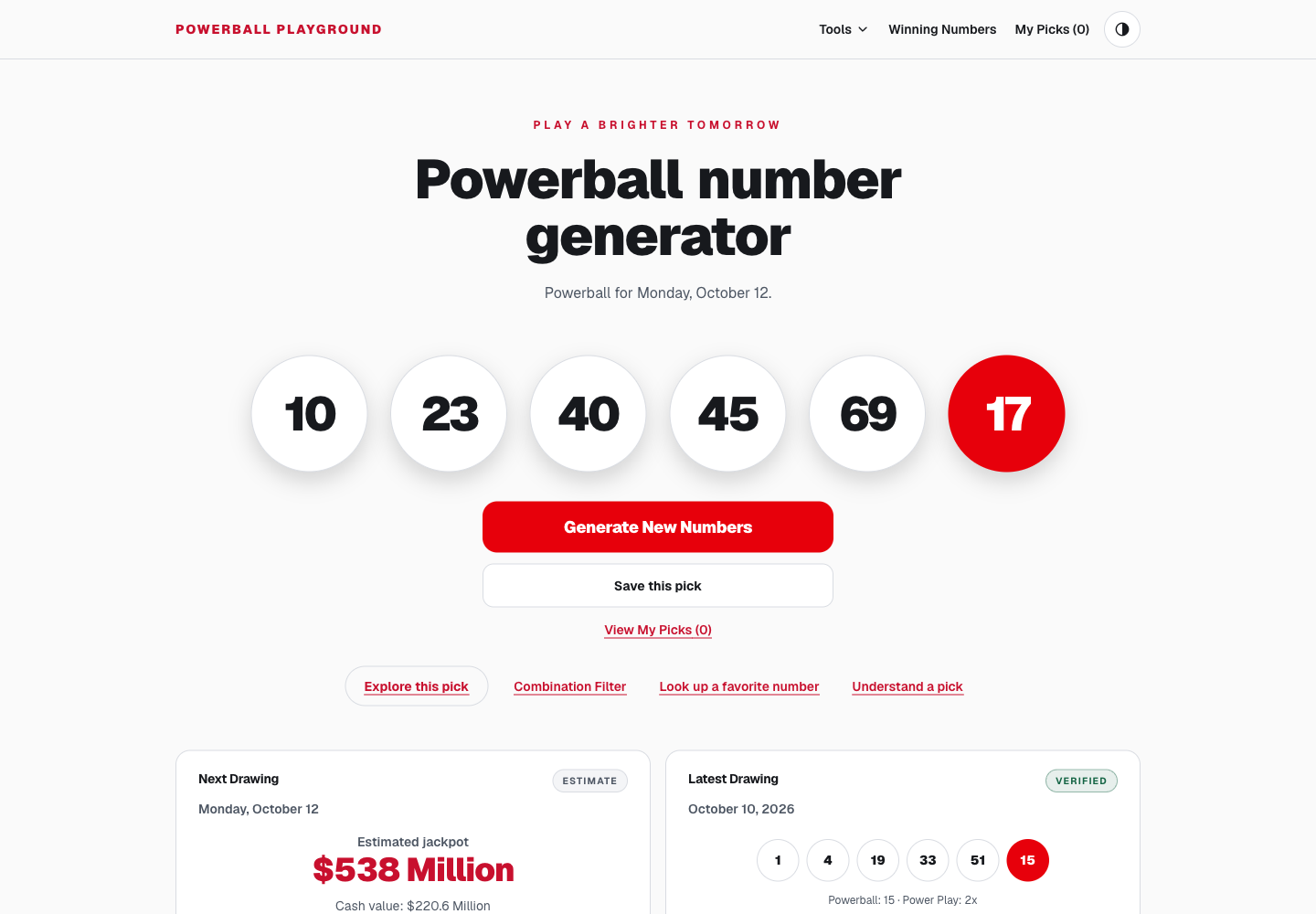
Powerball Playground is a web application for generating selections, exploring historical lottery data, saving numbers, and checking drawing results. The engineering challenge is to make those activities feel like parts of one product.
A selection made in one tool should remain useful in the next. Historical exploration, combination filtering, saved selections, and results checking need consistent data and predictable behavior. Responsive interfaces and social sharing support the way people discover and use the application.
The application uses Next.js App Router, React, TypeScript, and Tailwind CSS, with PostgreSQL on Neon for structured storage and queries. Historical imports require validation and duplicate prevention; ongoing drawing updates require source checks and reconciliation.
Scheduled processes retrieve external drawing results and handle information that can arrive late or become temporarily unavailable. This brings together APIs, database integrity, automation, and the user-facing presentation of time-sensitive data.
Vercel hosts the application, with GitHub workflows supporting development, review, and delivery. Unit, integration, and browser tests sit alongside production checks. Dependency maintenance, environment configuration, monitoring, and troubleshooting are part of continuing to operate the product.
Technical SEO, searchable routes, metadata, social previews, and Google Search Console are part of the work on discovery. They connect the application to the ways people find it and share it.
Autonomous coding agents help turn defined tasks into implementations. Our role in this project includes establishing requirements, evaluating architecture, coordinating changes, reviewing the code, and checking the resulting behavior. Tests and browser checks provide evidence, and each result needs to be understood in context.
That experience is useful beyond this product. It demonstrates a practical way to use modern development tools while keeping responsibility for decisions, quality, and the delivered work with us.
Carry a user’s numbers between generation, saved selections, historical exploration, and checking, so each feature contributes to a coherent experience.
Collect and import drawing information, validate sources, prevent duplicate records, and reconcile scheduled updates when data is delayed.
Translate a feature into bounded engineering tasks, review agent-generated changes, exercise the browser workflow, and verify behavior after delivery.
The ability to develop and operate a database-backed product: connect the interface, data, APIs, and delivery process, then keep improving it with meaningful review and verification.
Talk about your website